Owner's note
Why cheap dry cleaning is expensive for the industry
A dry cleaner cannot keep 2010 prices, pay 2026 costs, and still provide 2026-level service. Somewhere, someone pays for the difference.
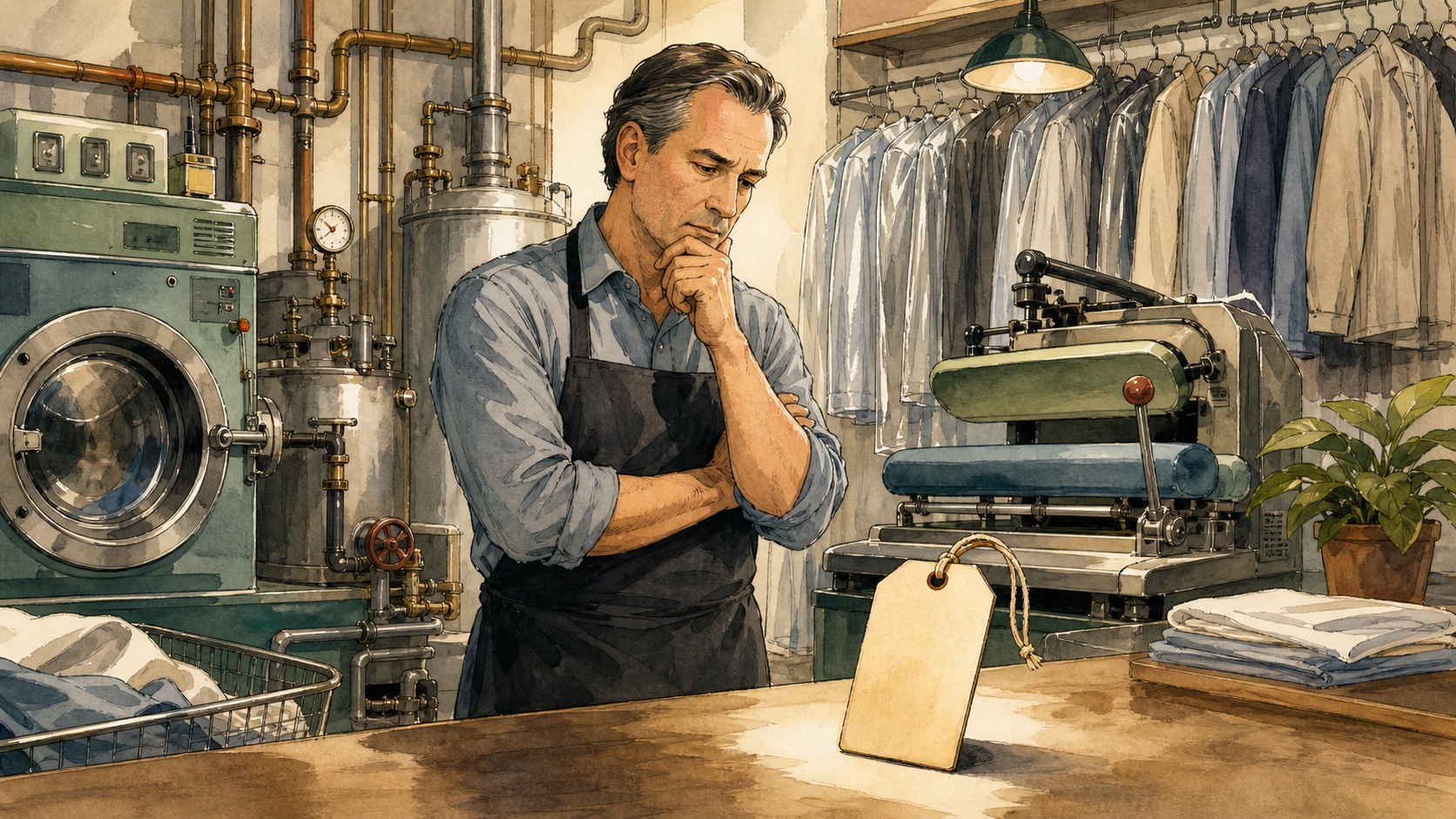
Last week, I visited another dry cleaner as a service mechanic.
Before I became more focused on running my own store, I worked on the mechanical side of dry cleaning plants. I fixed boilers, swamp coolers, dry cleaning machines, washers, presses, and the kinds of problems most customers never see. My father asked me to stop by a nearby cleaner to look at a used Cissell washer. The washer was acting strangely. From what I could tell, it was probably a computer or programming issue, not something I could repair on the spot.
That day, I ended up visiting three dry cleaners located almost on the same corner, maybe 0.2 miles from each other.
Since I was there, I asked each owner a simple question.
"How much do you charge to clean a pair of slacks?"
The answer surprised me.
$4.99. $5.99.
This was not 2010. This was the middle of 2026.
The old price structure does not match the new cost structure
I was shocked, but not because I had never seen prices like that. Around 2023, I was charging close to the same amount myself. At that time, it still felt possible to survive if the owner worked constantly, watched every expense, and absorbed most of the pressure personally.
But the math of this business has changed.
Supplies have gone up. Utilities have gone up. Labor has changed completely. In my own store, some costs doubled. Labor cost increased far more than that compared with just a few years ago.
So our prices had to change.
That was not an easy decision. Nobody enjoys raising prices. Customers notice. Owners worry. But after we made the change, something important happened: the business did not collapse. It became healthier. Gross sales more than doubled compared with 2023. Customer service improved. The quality of our work improved. The business became more organized. I became more of a semi-absentee owner, doing mostly management work instead of grinding every hour myself.
That experience taught me something I now believe very strongly: a dry cleaner cannot keep 2010 prices, pay 2026 costs, and still provide 2026-level service.
For years, the owner paid the hidden cost
For many years, dry cleaning survived on owner labor.
The owner worked 60 or 70 hours a week. The owner cleaned, pressed, spotted stains, fixed machines, handled customers, solved complaints, and carried the whole business on their back.
On paper, the business looked like it was operating.
In reality, the owner was often donating their life to keep prices low.
That model is breaking.
It is one reason many dry cleaning businesses are undervalued when they are appraised or sold. If the business only works because the owner personally grinds every day, then what is the business worth without that owner? Not much. The store may have customers, equipment, and history, but if there is no real system and no room for properly paid labor, the business becomes very fragile.
Why agencies are easier to sell
This is also why dry cleaning plants are hard to sell.
A plant store may have real equipment, real cleaning ability, trained production staff, and control over quality. But if it requires heavy owner involvement every day, many buyers hesitate. They are not only buying a customer list. They are buying the responsibility of running machines, managing skilled labor, fixing problems, controlling quality, and knowing what to do when something goes wrong.
That is a lot to take on.
By comparison, a dry cleaning agency with decent volume can look more attractive to buyers. There is no plant to operate. There are fewer machines to maintain. The production knowledge is outsourced. Management feels easier.
From a business buyer's point of view, the agency model can look cleaner, simpler, and less risky.
But that creates a strange problem for the industry. The businesses that are easiest to buy are not always the businesses that produce the best garment care. The businesses with the most control, skill, and responsibility may be harder to sell because they require more knowledge and more involvement.
That is one reason the industry keeps moving toward agencies and away from plants. Not because agencies necessarily do better work, but because they are easier to own.
And when ownership becomes easier by separating the store from the actual cleaning, something important gets lost.
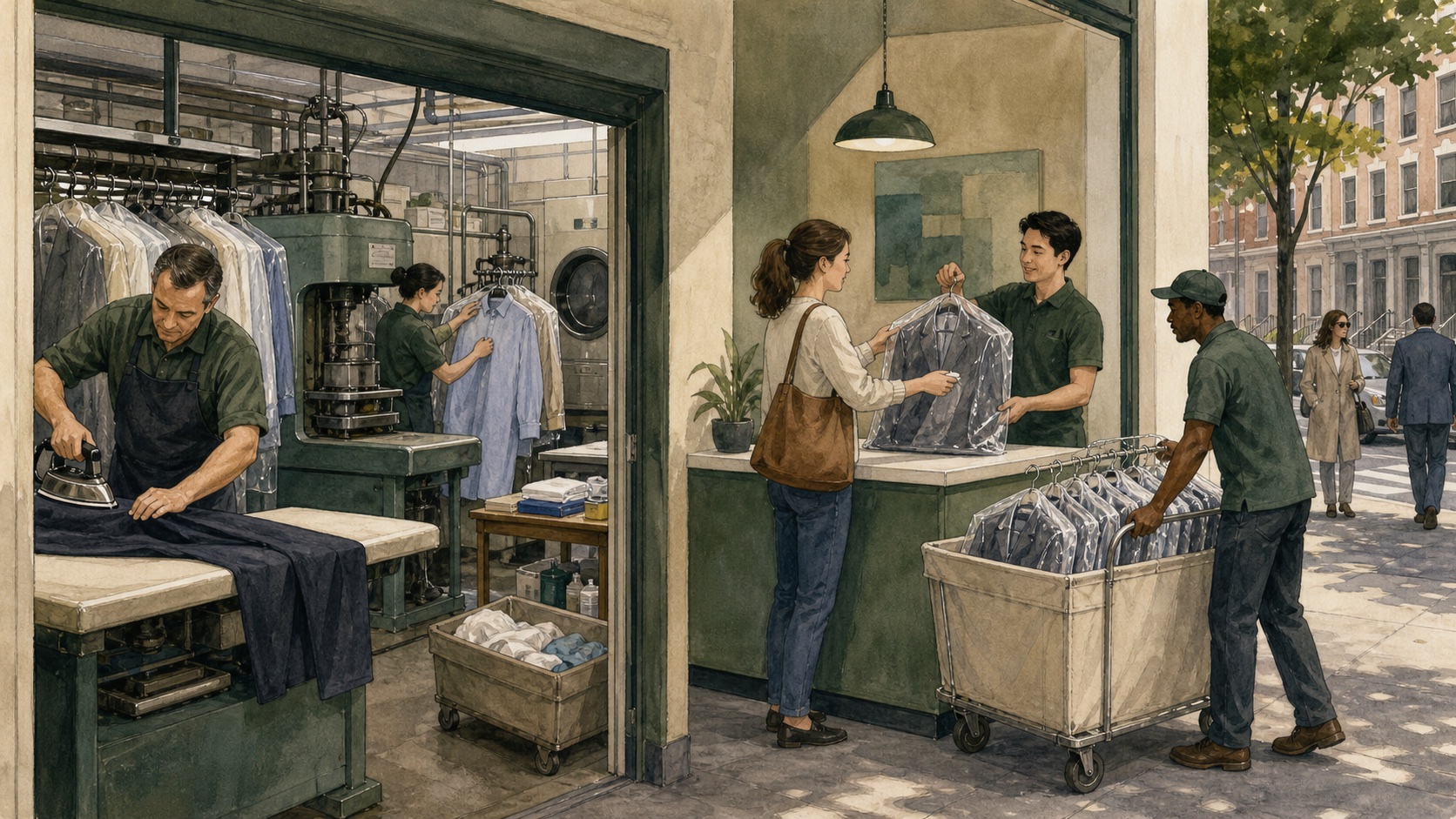
A dry cleaner sign can mean different things
To customers, many businesses look the same from the outside. There is a counter. There is a sign. You drop off clothes and pick them up later.
But behind that counter, there may be completely different operations.
One store may be a true plant store, doing the inspection, spotting, cleaning, pressing, finishing, and quality control under one roof. If something needs special attention, the people at the counter can speak directly to the people doing the work. If a stain needs to be pointed out, if a garment needs careful pressing, if a customer has a concern, that information stays inside the same operation.
Another store may be an agency. It may not clean the garments itself. It may send the work to a wholesale plant. A customer might pay a retail price at the counter while the actual cleaning is done elsewhere for only a few dollars per piece.
There is nothing automatically wrong with outsourcing if the quality is controlled. But in many cases, the business model is built around cheap wholesale production. The agency keeps the difference. The wholesaler has to move volume quickly. The customer often has no idea who actually cleaned the garment.
That is very different from a plant store.
Control matters.
Dry cleaning is not just a machine process
Dry cleaning is not simply putting clothes into a machine. It is judgment.
It is knowing when a stain is risky. It is knowing when fabric may bleed, shrink, shine, pull, pill, or distort. It is knowing when pressing can improve a garment and when too much heat can damage it. It is knowing when to keep working and when to stop before causing harm.
That kind of care is hard to provide when the whole system is built around being cheap.
This is especially visible in shirt pressing. A properly pressed shirt is not just flat. The collar, cuffs, placket, sleeves, seams, buttons, and body all have to be handled correctly. A rushed wholesale process may get the shirt processed, but the finishing often tells the truth.
The people doing the work have to be able to live
The issue is not only customer quality. It is also the people doing the work.
I used to tell my team members, "The only way for me to make money is for you to make money."
That is very important to me.
This industry has always depended on skilled labor, but too often it has paid as if the work is simple. Pressing is not simple. Spotting is not simple. Alterations are not simple. Customer service is not simple. Running a dry cleaning plant safely and consistently is not simple.
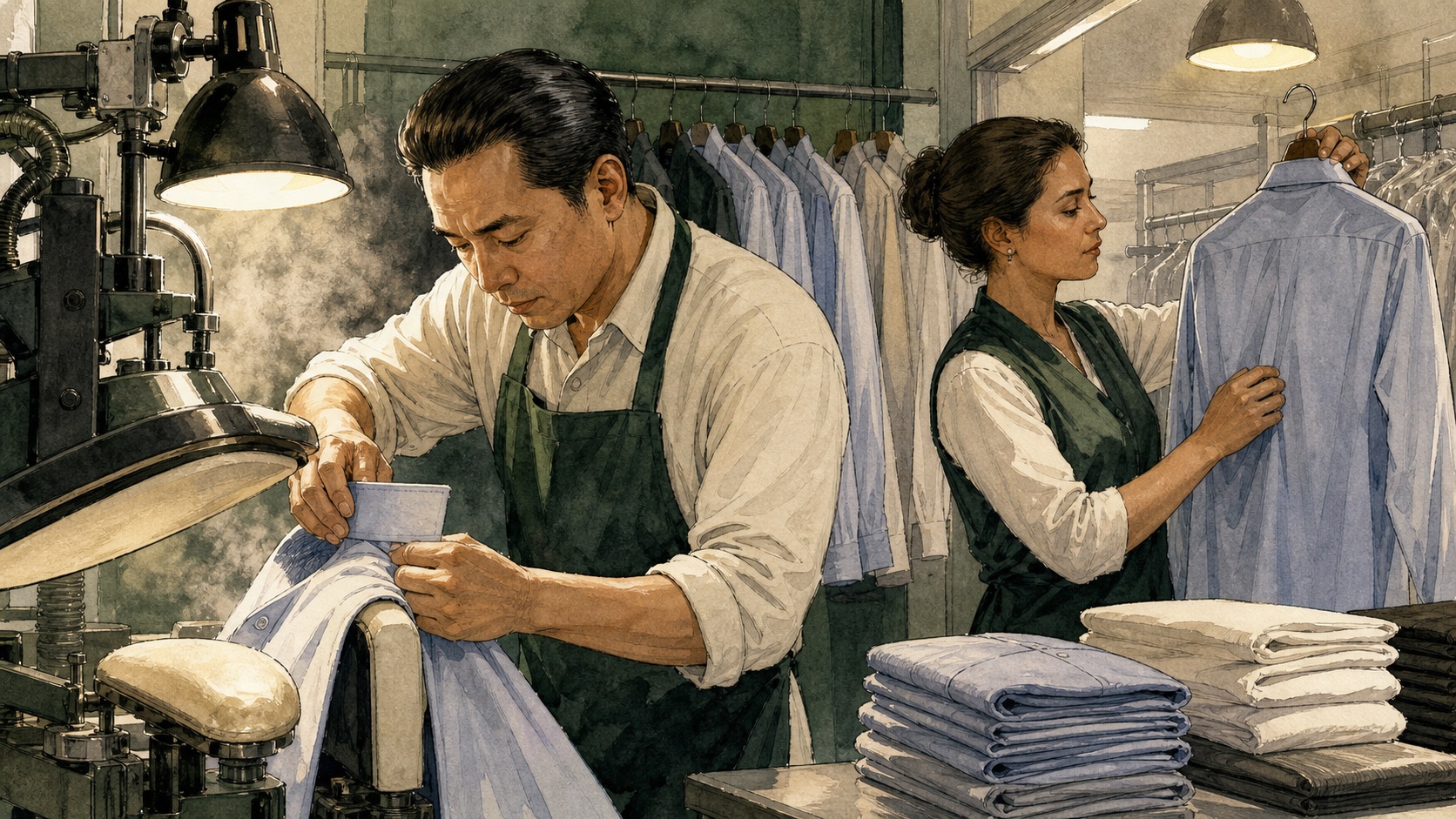
If we want better quality, better service, and better accountability, the people doing the work need a dignified income. They need to be able to stay, learn, care, and take pride in their work.
That is another part of the old model that has to change.
A cleaner cannot freeze prices, expect the owner to work 70 hours a week, expect employees to accept low wages, and still promise high-quality work. Something has to give.
For too long, what gave was usually the owner's life, the worker's income, or the customer's quality.
That is not a healthy industry.
My prediction for the next stage of dry cleaning
My prediction is that overall dry cleaning service quality will suffer as more mom-and-pop plant stores disappear.
In Southern California, from what I have seen over the past 15 years, a significant number of traditional dry cleaning plants have closed. My own estimate is that around 20 percent of mom-and-pop cleaners may be gone. At the same time, agency stores seem to be increasing.
That shift matters.
When plant stores disappear, customers do not just lose another storefront. They lose local cleaning knowledge. They lose pressers who know how a shirt should be finished. They lose spotters who have seen thousands of stains. They lose owners who understand the machines, the fabrics, the workflow, and the judgment behind the work.
Agency stores can be convenient. Some may be run responsibly. But if more of the industry moves toward drop-off counters and wholesale production, customers will have fewer true choices. They may still see dry cleaner signs, but fewer places will actually be doing the work themselves.
And when fewer people know how to do the work, quality suffers.
Cheap does not make the cost disappear
At Flower Fresh Cleaners, I am trying to build the business differently. Not perfectly, but intentionally. Better pricing should support better service, better systems, better equipment, better training, and better income for the people doing the work.
Because garment care is labor. Skilled labor. And skilled labor deserves respect.
I understand why customers look for a good price. Everyone does. But when dry cleaning is priced too cheaply for too long, the cost does not disappear. It shows up somewhere else.
It shows up in tired owners, underpaid workers, rushed production, poor finishing, weak quality control, and businesses that cannot survive the next generation.
That is the state of dry cleaning in 2026.
The industry is not struggling only because people dress more casually. That is part of the story, but not the whole story. The deeper problem is that too many cleaners are trapped between old prices and new costs. Some owners are still grinding themselves down. Some operators choose agency models because they are easier to manage. Some customers still expect garment care to cost what it cost years ago.
But good dry cleaning cannot be built on shortcuts forever.
If customers want real garment care, they need to understand what they are paying for. They are not only paying for solvent, steam, hangers, and plastic. They are paying for inspection, judgment, stain work, pressing skill, equipment, trained labor, accountability, and control.
That is what separates a plant store from a drop store.
And that is what I believe the future of dry cleaning has to be: fewer shortcuts, better service, honest pricing, and more respect for the work behind the counter.
Because cheap dry cleaning may look inexpensive at the counter.
But for the industry, for the workers, for the owners, and eventually for the customers, it can become very expensive.
A note from Flower Fresh Cleaners
We clean on-site, control our work, and believe garment care should support skilled labor, honest service, and better results for customers in Glendora.